


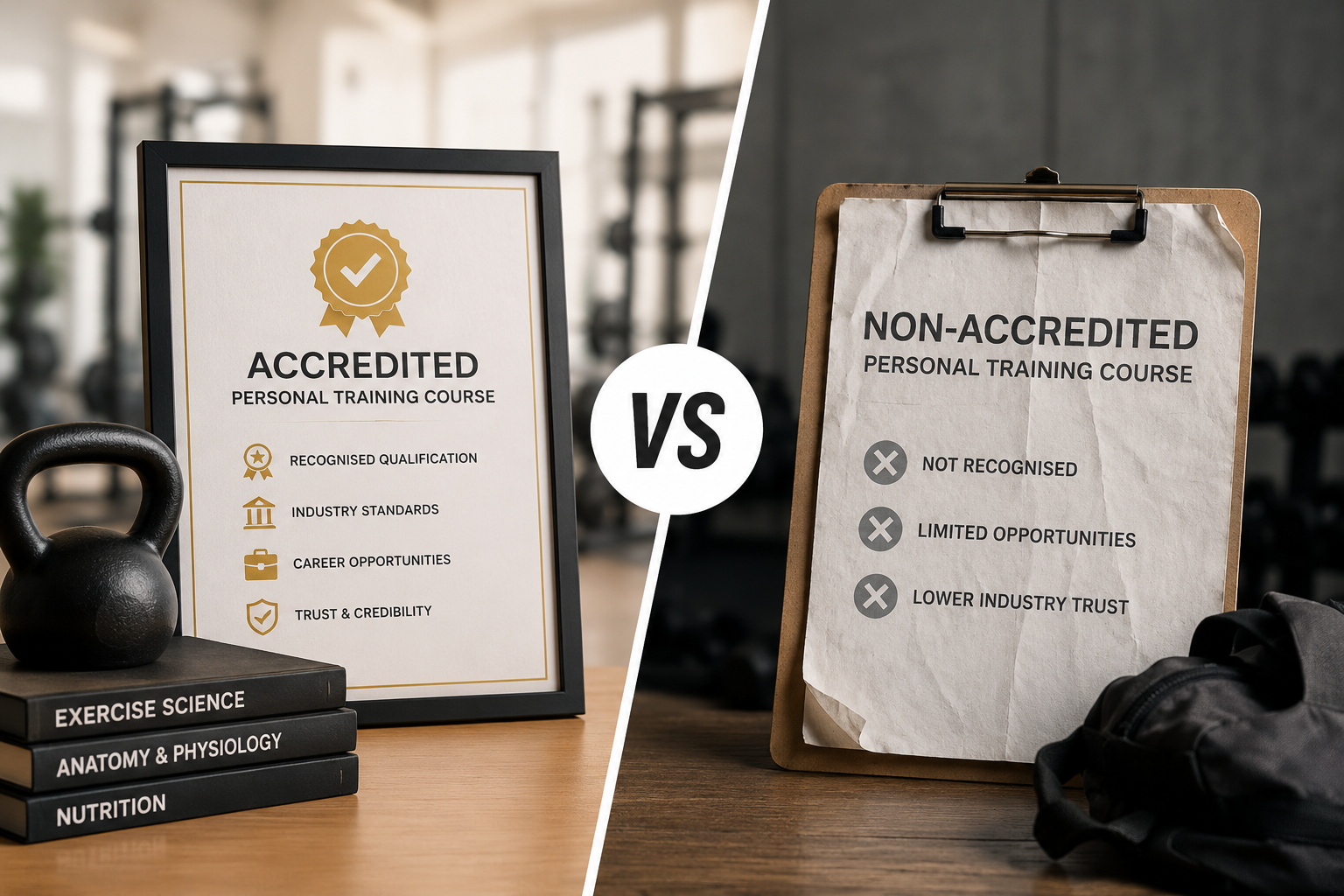
Things have changed significantly in the fitness industry in the last ten years. Years ago, someone could complete a weekend course, start training clients, and build a career from there. Employers, gyms, insurers, and even clients are expecting more these days. Qualifications are more valued, and individuals entering the industry are looking at where and how they learn.
This is why the debate about accredited vs non-accredited courses is important. When you’re spending your time and money on a fitness course, it’s important to know what it entails before you sign up.
What Makes a Course Accredited?
An accredited course is a qualification that meets recognised education and industry standards. In Australia, this usually means the course is delivered through a Registered Training Organisation (RTO) and forms part of nationally recognised training.
For students entering the fitness industry, this matters because recognised qualifications are tied to professional pathways. Employers know what the qualification includes, insurers recognise it, and the learning outcomes follow established standards.
With accredited personal training courses, students are generally completing structured education that includes:
- Practical coaching assessments
- Exercise programming
- Anatomy and physiology
- Client communication skills
- Safety and risk management
Qualifications such as the Certificate IV in Fitness in Victoria are designed to prepare students for real work environments, not simply theoretical knowledge.
What is a Non-Accredited Course?
A non-accredited personal training course is usually developed privately by an educator or company without being attached to a recognised qualification framework. That doesn’t automatically make the course low quality. Some are excellent for professional development or specialised learning.
The issue is that non-accredited courses are often misunderstood. People sometimes assume they hold the same professional recognition as nationally recognised qualifications, which is not always the case.
A non-accredited course may help someone:
- Learn new coaching techniques
- Develop niche fitness knowledge
- Improve confidence in specific training areas
However, it may not meet the requirements needed for:
- Commercial gym employment
- Professional insurance
- Industry registration
- Recognised career pathways
This distinction becomes important once someone starts applying for jobs or working with clients professionally.
Why Recognition Matters in the Fitness Industry
Fitness has become a far more professional industry than it once was. Gym operators and employers want trainers who have completed recognised education and practical assessment, particularly when client safety is involved.
That’s why terms such as regulated qualification, industry-recognised certification, and CIMSPA recognition carry importance.
A recognised qualification shows that a student has completed learning and assessment against established standards. Employers do not need to guess whether practical skills were properly assessed or whether the course covered the fundamentals required for professional practice.
Some keywords commonly searched online, such as “Ofqual-regulated course” and “REPs (Register of Exercise Professionals)”, are more closely connected to the UK fitness education system. In Australia, nationally recognised qualifications delivered through RTOs are the more relevant benchmark for professional recognition.
Want a qualification employers actually recognise?
Explore Our Fitness Courses
Accredited vs Non-Accredited Courses
| Feature | Accredited Course | Non-Accredited Course |
| Nationally recognised qualification | Yes | No |
| Delivered through a recognised education framework | Yes | Usually no |
| Accepted by most employers | Yes | Varies |
| Suitable for insurance requirements | Yes | Sometimes limited |
| Includes practical assessments | Yes | Not always |
| Long-term career pathway | Stronger | More limited |
| Can support employment in commercial gyms | Yes | Sometimes difficult |
| Useful for specialised learning | Sometimes | Yes |
| Professional credibility | Higher | Depends on the provider |
The Role of the Awarding Organisation
One of the most overlooked details when choosing a course is the awarding organisation behind the qualification.
Students often focus on pricing or course length while ignoring who actually issues the qualification. That can become a problem later. A recognised awarding body helps ensure the course meets proper educational standards and industry expectations.
Before enrolling in any personal training course, it’s worth checking:
- Whether the qualification is nationally recognised
- Whether the provider is an RTO
- What professional pathways does the qualification support
- Whether employers and insurers recognise it
These checks take a few minutes and can prevent a lot of frustration later.
Where CPD Courses Fit In
Not every course needs to be a full qualification. The fitness industry evolves constantly, and trainers often continue learning throughout their careers. That’s where CPD accreditation becomes valuable.
CPD stands for Continuing Professional Development. These courses are designed to expand existing skills rather than replace foundational qualifications.
For example, qualified trainers may complete CPD courses in:
- Strength and conditioning
- Sports performance
- Boxing fitness
- Mobility and recovery
- Nutrition coaching
This type of education works best when built on top of recognised qualifications rather than replacing them entirely.
Why Students Choose SR PT Education
At SR PT Education, we focus on delivering nationally recognised training that prepares students for real work in the fitness industry. Our courses, including the Certificate IV in Fitness in Victoria, are designed to give students both practical coaching experience and recognised qualifications that employers value.
Students choose us because we focus on:
- Practical coaching skills
- Nationally recognised qualifications
- Real industry preparation
- Support from experienced trainers
- Career-ready fitness education
A quality personal training course should prepare students to work confidently with real clients, not just complete online theory. That’s the standard we aim to maintain across our programs.
Why Students Choose Nationally Recognised Training
The Certificate IV in Fitness qualification from Victoria provides students with an industry-recognised pathway while they develop practical skills through their studies.
The combination of these two elements holds importance because fitness experts maintain direct contact with clients who want to enhance their health, performance, and overall well-being. Trainers need to master programming, movement, safety, and progression to meet client expectations.
A recognised qualification helps build that foundation.
Final Thoughts
The debate of accredited vs non-accredited courses centers on how these programs affect professional recognition and career advancement opportunities and the credibility of certification holders.
The fitness industry needs non-accredited courses to meet its requirements because these programs offer specialised training and ongoing educational opportunities. For individuals beginning their fitness careers, accredited qualifications offer more dependable educational support than non-accredited programs.
You should investigate the course content and delivery method, its recognition status, and subsequent benefits before deciding on a course. The details hold greater significance than the advertising and claims of instant success that businesses use to market their products.
FAQs
What is the difference between accredited and non-accredited courses?
The difference between accredited and non-accredited courses exists because accredited courses receive professional recognition while non-accredited courses do not. Accredited qualifications meet recognised industry and education standards, while non-accredited courses are designed for additional learning or specialised skills without formal qualification status.
Why are accredited personal training courses important in Australia?
Accredited personal training courses provide nationally recognised qualifications that are accepted by employers, insurers, and fitness organisations. The program guarantees students will finish their mandatory educational requirements by completing both theoretical studies and practical work evaluations, which will help them become fitness professionals.
What does an awarding organisation do?
An awarding organisation oversees qualifications and ensures they meet the required educational standards. The organisation ensures assessment methods, learning outcomes, and qualification standards remain constant, which enables employers and industry organisations to trust the certification process that students go through.
Is CPD accreditation the same as a full qualification?
No, CPD accreditation designates professional development courses that help people build upon their existing skills and knowledge base. These courses support ongoing education but usually do not replace nationally recognised fitness qualifications needed for professional employment.
Why does CIMSPA recognition matter in fitness education?
CIMSPA recognition helps demonstrate that a qualification aligns with recognised professional standards within the fitness industry. The system offers trainers additional validation, which helps employers confirm that their educational background meets established industry standards pertaining to knowledge and professional behavior.