



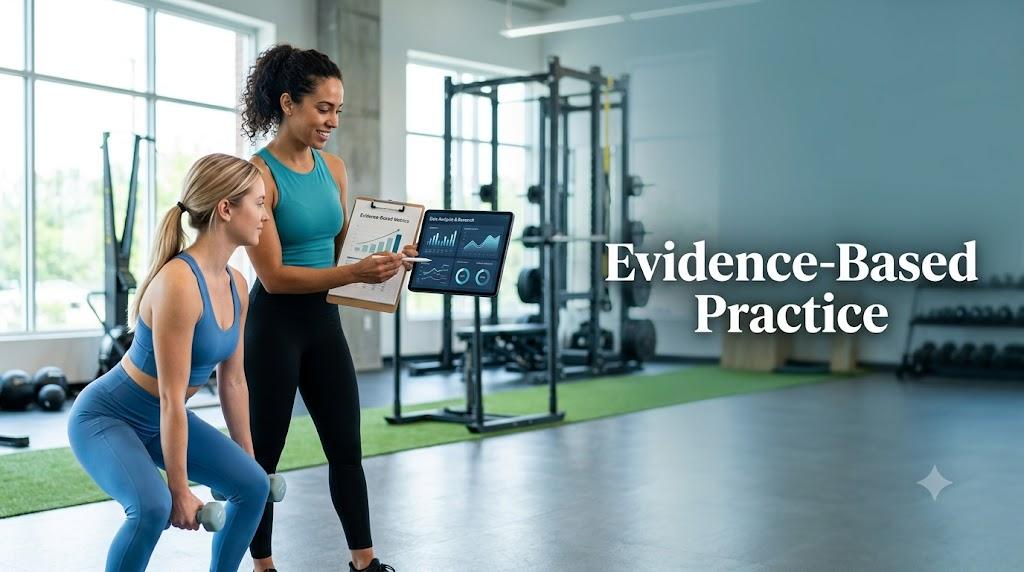
Evidence-based personal training requires making decisions based on sound scientific information, your experience as a coach, and the individual needs of clients. Guesswork is replaced by the use of proven techniques; this is what makes evidence-based personal training effective and reliable.
Fitness advice changes every week. A new gadget, a new rule, a new promise. Knowing what the research actually supports is part of the job now. SR PT Education covers it from the start of your training.
So what does evidence really change inside a session? And why should it shape every program you write? Stick with us, because the gap between guessing and coaching properly is wider than most new trainers realise.
What Does Evidence-Based Practice Actually Mean for a Personal Trainer?
It rests on three pillars working together. The first is high-quality research, such as systematic reviews and controlled trials. The second is your own experience, which is part of developing the essential skills for successful fitness professionals, while the third is understanding the client’s goals.
Remove any one and the plan weakens. Research alone ignores the person in front of you. Experience alone can repeat old habits. Doing only what a client asks can overlook what’s safe.
| Pillar | What it adds |
| Research evidence | Methods that have been tested |
| Trainer expertise | Real-world judgement |
| Client values | Plans people will follow |
Why Is Evidence-Based Personal Training So Important for Client Results?
Australia’s health picture makes this urgent. According to AIHW, 3 in 5 Australians suffered from chronic conditions in 2022.
Also, as per ABS, 65.8% of Australian adults in 2022 were either overweight or obese. These figures highlight the important role physical activity can play in supporting Australians’ health and wellbeing.
Proven methods stand up better than passing trends
Trends spread faster than research does. A viral clip can push thousands toward a method with thin evidence behind it. Good trainers check the science before adding it to a program.
Smarter training load management cuts avoidable risk
Progressive loading is one of the clearest examples of research guiding practice. The Australian Institute of Sport notes that sudden load spikes raise injury risk. Building volume gradually gives the body room to recover.
Grounded advice earns trust faster
Clients can usually spot a sales pitch. When a trainer explains why a plan looks the way it does, confidence grows. That trust keeps people engaged and training on track.
How Does Evidence-Based Practice Improve the Results Clients Can See?
What gets measured tends to get managed. Without tracking, progress is just a feeling. With the right numbers, a trainer can spot a genuine plateau from a plan that needs a tweak.
Tracking real client outcome measures
Measures such as strength, mobility, body composition, and energy levels should be tracked as well. Going back to these every several weeks will reveal whether the program is succeeding or failing.
Programming around genuine training adaptation
Training adaptation is the body’s response to repeated, progressive stress. Evidence can help a trainer decide how much to apply, when to back off, when a client may be showing signs of doing too much, and when to change things up.
Aligning plans with national activity guidelines
As per Australia’s 24-hour movement guidelines, it is advised that adults progress to a goal of 150-300 minutes of moderate exercise per week and strength exercises on at least two days a week.
Ready to start your fitness career with evidence-led training?
Book a Free Career Consultation
Why Does Screening Clients Matter for Safe Programming?
A movement assessment involves a trainer observing or screening how you move and referring you to allied health professionals where required.
Honesty matters here. Studies on tools like the Functional Movement Screen show mixed results. The data on reliability is only fair. When it comes to predicting injury, findings vary too. Overall, a screen is more like a starting point than a sure outcome.
How Do Australian Qualifications Teach Evidence-Based Skills?
In Australia, training has to match rules from the Australian Skills Quality Authority. The SIS30321 Certificate III in Fitness gives the basics. The SIS40221 Certificate IV in Fitness covers assessment and planning in more detail.
That matters if you’re weighing up a SIS40221 Certificate IV in Fitness in Australia. A strong course teaches you to embrace evidence-based personal training from day one, not chase trends. Theory only works when it’s paired with supervised practice.
Why SR PT Education Puts Evidence Ahead of Guesswork
At SR PT Education, we built our training around practical, evidence-based personal training rather than hype. Students study online, then apply that knowledge inside working gyms with mentors guiding each step. Having someone experienced around you can make a real difference when you are still learning, which is why a fitness mentor can be worth it during practical training.
What sets our approach apart:
- Nationally Recognised Qualifications: Ensuring your certification is respected industry-wide.
- Flexible Online Study: Balancing your theory coursework with your current lifestyle and commitments can make it easier to keep progressing without putting everything else on hold.
- Australia’s Largest Practical Training Network: Train across a vast network of premier facilities.
- Practical Training within Actual Gym Settings: Your practical training will be done within an actual operating gym environment and not within the classroom setting.
- Guidance from Industry Professionals: Work directly with professionals to gain hands-on experience within the field.
- Partnerships with Major Gym Brands: Partner with companies such as Snap Fitness, Genesis, Club Lime, and World Gym.
- Career Opportunities through SRPT Recruitment: We help link up our students with job opportunities in our partnered gyms.
We don’t just hand over a certificate. We help students understand the thinking behind each session, so they are better prepared for what it will be like to work as a personal trainer in 2026.
The Bottom Line on Evidence-Based Coaching
Fitness will always have fads. What separates a trainer who guesses from one who delivers is evidence. If you want to build that skill properly, SR PT Education’s personal training course is a solid thing to start with.
Look for training that teaches you to think, not just follow a script. That’s what good coaching means, and it’s what keeps clients coming back over the long haul.
FAQs
1. What is evidence-based practice, and how does SR PT Education teach it?
It means coaching decisions rest on research, experience, and each client’s needs. SR PT Education’s personal training course teaches students to question claims, assess clients properly, and build programs on methods that hold up.
2. Do I need to have a qualification in order to be a personal trainer in Australia?
Yes, you need a qualification to work as a qualified personal trainer in Australia. A Certificate III in Fitness (SIS30321) generally provides the pathway for gym/group exercise instruction, while SIS40221 Certificate IV in Fitness is the relevant vocational qualification for working as a personal trainer.
3. How does an evidence-based trainer measure client progress?
The objective markers include strength, mobility, body composition, and the way the client feels each week. This will show whether the program is working or not, and changes can be made to volume or recovery.
4. Can evidence-based practice stop clients from getting injured?
No approach can eliminate injury risk entirely. Evidence-based practice minimises unnecessary risk through gradual progression, movement screening, and adaptation to individual needs.
5. What qualities should I expect in a good fitness training program?
Focus on nationally recognised training with plenty of practical training hours and mentors with industry experience. Make sure that the training involves anatomy, programming, and assessment of clients. Find out who certifies you.
